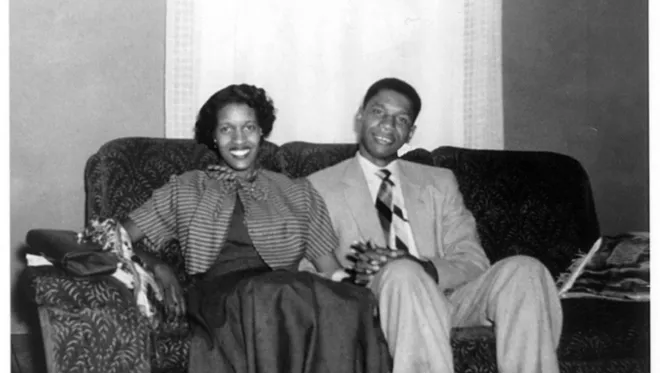
You Had Me At Hello: The Love and Legacy of Medgar and Myrlie Evers
by Birmingham Times · The Birmingham TimesThe Birmingham Times
The love story of civil rights icons Medgar Evers and Myrlie Evers goes hand in hand with the story of Black people’s fight for freedom in the 1950s and 1960s. Together, they built a marriage rooted in faith, courage and a shared determination to challenge white supremacy in Mississippi and beyond. The couple’s relationship shaped the fight for civil rights and Myrlie bravely carried on their mission after Medgar’s assassination.
Medgar and Myrlie first met at Alcorn Agricultural and Mechanical College in Mississippi in 1950. Medgar, a 25-year-old World War II veteran, had returned home and was instantly captivated by Myrlie, a 17-year-old gifted singer and pianist from Vicksburg, Mississippi. Myrlie later recalled noticing his confidence and seriousness, while Medgar admired her intelligence and poise. Their connection was almost immediate. Within a year, the two were married on Christmas Eve in 1951.
Their wedding marked the beginning of a partnership that would become deeply intertwined with the freedom struggle. After marrying, Myrlie stepped away from her own academic ambitions to help raise their family and support Medgar’s growing activism. The couple eventually had three children: Darrell, Reena, and James. But theirs was no ordinary family life as Medgar became increasingly involved with the National Association for the Advancement of Colored People (NAACP). In 1954, he was appointed the organization’s first field secretary in Mississippi, which at the time was one of the most dangerous states for Black people.
Back then, Mississippi was considered one of the most violently segregated states in the nation. Black citizens who attempted to register to vote or challenge segregation often faced beatings, economic retaliation, imprisonment, or death. Medgar traveled constantly, investigating racial murders, organizing boycotts, encouraging voter registration, and helping coordinate legal challenges to segregation. One of his most important campaigns involved efforts to desegregate the University of Mississippi when James Meredith sought admission in 1962.
Throughout those years, Myrlie worked beside her husband in ways that often went unseen publicly. She typed letters, organized schedules, answered phones, helped manage NAACP business, and served as Medgar’s closest adviser and emotional support system. Their home in Jackson became both a family residence and a civil rights headquarters, filled with meetings and strategy sessions.
As Medgar became more visible nationally, the danger to the Evers family intensified and they lived under relentless threats. Medgar and Myrlie even taught their children emergency drills in case of attack. Medgar routinely changed driving routes to avoid ambushes. In May 1963, just weeks before his death, a Molotov cocktail was thrown into the family carport. Fortunately, the firebomb did not kill anyone, but it showed how vulnerable the family had become. Ten days later, Medgar was nearly run over by a car after he came out of the NAACP office in Jackson.
Despite the danger, Medgar refused to stop his work. He believed deeply that Mississippi could change and that Black Americans deserved full citizenship rights. In speeches and interviews, he often emphasized dignity, voting rights, and equal opportunity. His activism made him a target of white supremacist groups, including members of the Ku Klux Klan.
Late on the night of June 11, 1963, Medgar returned home after attending an NAACP meeting and watching President John F. Kennedy deliver a televised civil rights address. As he stepped out of his car carrying NAACP T-shirts that read “Jim Crow Must Go,” a sniper hiding nearby fired a rifle shot that struck him in the back. Medgar collapsed in the driveway in front of his wife and children. He was rushed to a local hospital but died less than an hour later. He was only 37 years old.
His assassination shocked the nation. At that moment, Medgar Evers became one of the most prominent civil rights leaders killed during the movement. Thousands mourned him, and he was buried with military honors at Arlington National Cemetery.
In the years after Medgar’s death, Myrlie transformed her pain into purpose. She fought tirelessly for justice against Byron De La Beckwith, the white supremacist charged with murdering her husband. Although two all-white juries deadlocked in the 1960s, allowing Beckwith to avoid conviction for decades, Myrlie never stopped pursuing justice. Her persistence helped lead to Beckwith’s eventual conviction in 1994, more than 30 years after the assassination.
Myrlie also worked to preserve Medgar’s legacy through writing and public advocacy. In 1967, she co-authored the book For Us, the Living, which chronicled Medgar’s life and work and was later adapted into a film. She later became a nationally recognized speaker and activist in her own right. Her career included an unsuccessful run for Congress and leadership roles within major civil rights organizations. Most notably, she served as chairwoman of the NAACP from 1995 to 1998, guiding the organization during a period of financial and organizational difficulty.
Over time, Myrlie emerged as one of the most respected voices of the Civil Rights Movement generation. In 2013, she delivered the invocation at the second inauguration of Barack Obama, a powerful symbol of how far the country had come since the days when her husband fought for Black Mississippians simply to vote safely.
In 2024, journalist Joy-Ann Reid published the book “Medgar and Myrlie: Medgar Evers and the Love Story That Awakened America.” The book portrays Medgar and Myrlie not only as activists, but as husband and wife, parents, and partners. Reid presents Myrlie not merely as the widow of a martyr, but as an equal partner in the movement whose labor, sacrifice and leadership were essential to the fight for freedom. Furthermore, Reid argues that the marriage of Medgar and Myrlie was itself an act of resistance.
Today, the Medgar and Myrlie Evers Home National Monument in Jackson, Mississippi, stands as a reminder of both the dangers the couple faced and the legacy that they left behind. Their lives helped transform America, and their story continues to inspire new generations committed to justice, equality and the enduring power of love.
Sources: naacp.org, Wikipedia, “Medgar and Myrlie” by Joy-Ann Reid
Built to Last: Share Your Love Story
What does lasting love look like? Maybe it’s handwritten notes tucked into lunch bags, dancing in the kitchen after a long day, praying together through hard seasons, or simply choosing each other again and again over the years. Whatever your story looks like, we want to hear it.
For years, the Birmingham Times has celebrated local couples and the love that binds them through our popular “You Had Me at Hello” column. Now, we’re looking for more inspiring stories of commitment, partnership, laughter, resilience, and romance.
Have you been married seven years or longer? Tell us the secret to your enduring love. No relationship is ordinary, and every couple has a story worth sharing. Your journey could encourage newlyweds, inspire singles, or remind readers that lasting love still exists.
Whether your love story began with a blind date, a high school romance, a chance encounter, or friendship that grew into forever, we’d love to feature it.
To be considered for a future “You Had Me at Hello” column or to nominate a couple you admire, email editor@birminghamtimes.com with the couple’s names, contact information, and the number of years they’ve been married.