UPI Charges Explained: New 0.4% MDR Above ₹2,000 From October 15
by Vinay Kakkad · KalingaTVAdvertisement
For years, the appeal of UPI has been almost embarrassingly simple: scan, enter the amount, pay and move on. There has been no visible fee attached to the transaction, whether someone was paying a shopkeeper, buying a meal or sending money to a friend.
That changes from October 15, 2026 — although not quite in the way the phrase “UPI charges” suggests.
The new framework introduced by the National Payments Corporation of India (NPCI) puts a 0.4% Merchant Discount Rate (MDR) on eligible UPI payments of more than ₹2,000 made to merchants. The charge is payable within the merchant-side payment ecosystem, rather than by the individual making the payment.
So the familiar UPI experience is changing — but the government is simultaneously stressing that UPI itself is not becoming a paid service for consumers.
The distinction is at the heart of the new rules.
So, will you actually have to pay to use UPI?
For ordinary person-to-person transfers, no.
The Finance Ministry has clarified that sending money from one individual to another will remain free regardless of the amount. There will also be no monthly quota, transaction-volume limit or tiered ceiling on free P2P transfers. UPI applications cannot impose a separate platform fee or hidden charge on individuals for these transfers.
The same applies to merchant payments of ₹2,000 or less, which will remain outside the MDR framework.
That means someone paying ₹500 at a shop, sending ₹1,500 to a friend or transferring ₹2,000 to a merchant will not suddenly see a UPI fee added to the payment.
The change is concentrated on higher-value person-to-merchant transactions.
What happens when the payment crosses ₹2,000?
For a normal merchant transaction above ₹2,000, the MDR will be 0.4%.
A ₹10,000 payment, for example, would generate an MDR of ₹40 within the merchant payment system. At ₹20,000, it would be ₹80; at ₹50,000, ₹200.
Once the transaction reaches ₹75,000, the 0.4% calculation would produce ₹300. Beyond that point, the charge remains capped at ₹300.
The important part is who is supposed to bear that cost.
The Finance Ministry has said banks have been advised to ensure that merchants do not pass the MDR on to customers. The ministry has also clarified that the MDR is not a tax collected by the government or NPCI.
The ₹2,000 rule is not the whole story
The new system creates several different buckets rather than applying one charge to every UPI payment.
For certain frequently used services, a flat ₹5 MDR will apply to transactions above ₹2,000. These include railways, telecom services, insurance and fuel, with the framework also covering specified utility and agriculture-input payments.
So a ₹10,000 UPI payment for a railway ticket or an eligible fuel transaction would not attract the standard 0.4% rate. It would fall under the ₹5 structure.
Advertisement
Payments below ₹2,000 in these categories remain outside the charge.
There is another concession for capital-market transactions. Payments involving mutual funds, securities, stockbrokers and dealers will attract an MDR of 0.02%, subject to a maximum of ₹300 per transaction.
Recurring payments made through UPI mandates, including AutoPay for OTT subscriptions and recurring investments, also remain outside the new MDR structure.
Small shopkeepers are being treated differently
The government is also drawing a line between large merchant transactions and the tiny businesses that have become heavily dependent on QR-code payments.
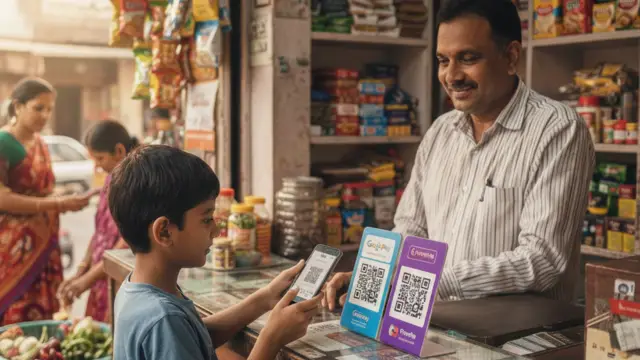
Small merchants receiving up to ₹1 lakh a month through UPI QR codes directly into their bank accounts under the Person-to-Person Merchant (P2PM) classification will continue to receive zero-MDR treatment.
They will not have to replace their existing QR codes or go through a fresh registration process.
Banks and payment service providers will track the ₹1 lakh monthly threshold. A merchant whose aggregate UPI inflows exceed ₹1 lakh for three consecutive months can be moved into the regular Person-to-Merchant category, bringing eligible transactions under the new MDR framework.
That distinction matters because UPI’s expansion has not been limited to large retailers. QR codes have become a basic payment tool for small vendors, street businesses and merchants in smaller towns and rural areas.
Why introduce a charge now?
The timing is significant because UPI is no longer a small digital-payment experiment.
Launched in 2016, the system has become one of the world’s largest real-time interoperable payment networks. In August 2026 alone, UPI processed about 24.5 billion transactions, worth roughly ₹29.9 lakh crore.
At that scale, the question is no longer simply how to encourage people to use UPI. It is also how to finance the infrastructure supporting billions of transactions every month.
The government and NPCI have positioned the MDR framework as part of that effort, pointing to requirements such as infrastructure, cybersecurity, fraud prevention, innovation and expansion of digital payments into rural and semi-urban areas. Reuters reported that the framework is intended to distribute revenue across banks, payment applications and other service providers while supporting the resilience of the network.
The Finance Ministry’s own clarification also frames the change around making UPI more self-sustaining while keeping the overwhelming majority of everyday payments free.
The number that matters most: 95%
The government says the new framework will not affect most everyday UPI payments.
More than 95% of merchant transactions are below ₹2,000, according to the Finance Ministry’s clarification, while the broader framework is designed to leave roughly 96% of merchant transactions unaffected through exemptions and zero-MDR provisions.
That is why the policy is more accurately described as a shift in the economics of higher-value merchant payments than as a blanket UPI fee.
For someone buying groceries, splitting a restaurant bill with friends or making a small QR payment, little changes.
The difference becomes relevant when UPI is used for a larger purchase from an ordinary merchant.
Advertisement