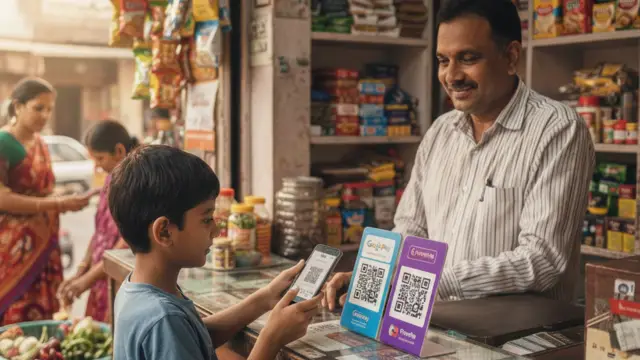
Digital Payments Boost Indian Household Spending by 7.5%
by Vinay Kakkad · KalingaTVAdvertisement
New Delhi: Digital commerce in India is driving higher household spending, though adoption remains sharply skewed by income levels and concentrated in non-perishable categories, according to findings released on October 30 by the State Bank of India (SBI).
Families using digital channels record 7.5 per cent higher Monthly Per Capita Consumption Expenditure (MPCE) than those dependent on conventional cash channels, the SBI research report noted. The bank observed that moving away from offline payments directly coincides with stronger consumption intensity and a broader, more diversified basket of household purchases.
Adoption, however, mirrors an economic divide. Digital purchasing stands at 25.3 per cent among the bottom 20 per cent of households by MPCE, before climbing to 69.5 per cent among the top 20 per cent. This represents a 44.3 percentage-point gap between the lowest and highest income quintiles, pointing to a pronounced consumption gradient across the country.
Nationwide, 45.6 per cent of Indian households now use digital payment methods or web platforms to buy at least one consumption product. Conversely, 54.4 per cent of households across the country have yet to use digital transaction channels for their shopping needs.
Geographically, Haryana leads the nation in average monthly consumer spending across food, consumables and services, as well as durable goods. Other top-performing states across core spending segments include Goa, Nagaland, and Kerala.
By spend category, consumables and services capture the largest share of digital transaction activity at 39.68 per cent, followed by durable goods at 23.3 per cent.
Advertisement
General services dominate online activity within the consumables bracket at 37.93 per cent, alongside fuel and lighting at 15.96 per cent. Essential services, however, see subdued digital footprints, with education transactions logging 1.83 per cent and medical services registering 1.69 per cent.
Within consumer durables, apparel leads digital uptake at 19.97 per cent, followed by footwear at 12.05 per cent. Big-ticket household acquisitions show minimal online penetration: medical equipment stands at 0.32 per cent, while furniture and fixtures register at 0.18 per cent.
The most traditional habits persist in groceries and fresh produce. Digital food purchases represent only 7.10 per cent of all online transactions, despite food making up roughly 32.82 per cent of total household consumption expenditure—a dynamic the report attributed to the continued dominance of basic daily sustenance in household budgets.
Where food transactions do happen digitally, routine packaged groceries lead at 4.29 per cent, followed by served processed meals at 2.6 per cent and packaged processed items at 1.65 per cent.
Fresh perishables remain overwhelmingly tied to neighborhood wet markets and local vendors. Digital adoption falls to 1.32 per cent for vegetables, 1 per cent for fresh fruits, and 0.59 per cent for poultry, meat, fish, and eggs.
(Source: ANI)
Advertisement