'He was incredible at just meeting people where they were'
‘Bring light to the world’: Journalist preserves slain Bondi rabbi’s mission in joint book
Treatise on faith and purpose becomes a memorial for Rabbi Eli Schlanger after he was killed at the Hanukkah beach party he organized last December in Sydney
by Zev Stub Follow You will receive email alerts from this author. Manage alert preferences on your profile page You will no longer receive email alerts from this author. Manage alert preferences on your profile page · The Times of IsraelJournalist Nikki Goldstein remembers the last time she met with Rabbi Eli Schlanger. It was just days before he was killed by a terrorist at the Hanukkah party he organized last December on Sydney’s Bondi Beach.
“He had a two-week-old baby at that point, and as we finished work for the day on the book we were working on, he just sat back in his chair and grinned like a Cheshire cat,” Goldstein said.
She asked him what the smile was about.
“I’m just so happy,” Goldstein recalled him saying. “I’ve got five beautiful, healthy children. I love my wife, I love my family, and I’m completely doing what I’m meant to be doing. I’m on my path.”
But Schlanger’s path would be brought to a premature end the following Sunday, when two Islamic State-inspired terrorists opened fire on participants at the annual Hanukkah by the Sea candlelighting party he arranged. The holiday celebration, attended by about 1,000 members of Sydney’s Jewish community, became a day of darkness as 15 people, including the 41-year-old Schlanger, were shot dead, and dozens of others were injured in one of the deadliest antisemitic attacks in recent memory.
Goldstein was “in shock” when she heard the news of Schlanger’s death, but she later became aware that the book on the teachings of Judaism she’d been working on with him for almost a year would come to serve as more than just a religious guide.
“I woke up in the morning knowing that Eli’s legacy, his mission to bring light and love to the world, would not die with him. Through the hours of conversations, he had prepared me to be his herald, his foot soldier, and his torch bearer,” Goldstein wrote in the introduction to her new book, “Conversations with My Rabbi: Timeless Teachings for a Fractured World.”
Goldstein, who is not religiously observant, co-wrote the book with Schlanger as a guide for non-Jews to the universal, ethical teachings of the Noahide Laws, rooted in Jewish wisdom and the teachings of the Chabad Hassidic movement. After Schlanger’s death, the project has taken on the additional task of serving as a memorial to his life.
A preordained meeting
Looking back, Goldstein said the story of how they met and came to write the book together now feels almost preordained. The pair had just begun work on the final chapter when Schlanger was killed.
“Eli chose me for this task,” she said. “This book is part of how his light keeps going.”
Goldstein says she vividly remembers meeting Schlanger, even though she wasn’t conscious at the time. In September 2022, she was in intensive care at Sydney’s St Vincent’s Hospital, suffering from a severe flare-up of a longstanding lung disease.
Doctors placed her in a medically induced coma and warned her family to prepare for the worst. As they waited, her daughter spotted a man in traditional Jewish dress.
“Dad, isn’t that a rabbi?” she asked.
Goldstein’s husband, Rowan, who is not Jewish, approached the man and asked him to pray for his wife. The rabbi went to her bedside, recited prayers, and, with the nurse’s permission, blew a shofar he was carrying ahead of Rosh Hashanah.
Goldstein did not awaken when the blasts echoed through the room. But against the odds, her condition began improving within a day. When she emerged from the coma, she told her husband she could feel people praying for her.
“I knew people were praying,” she said. “Later, I found out there were actually prayer groups all over the world praying for me. But this one specific Jewish prayer is what I believe changed the course of my life.”
A few days later, the rabbi appeared in the doorway of her recovery room, startled to see her sitting up. “You’re alive,” he said.
He introduced himself as Rabbi Eli Schlanger, the hospital’s chaplain.
Goldstein, a self-described “secular Jew looking in all the wrong places for answers” who knew little about Judaism beyond her family’s Holocaust story, found Schlanger’s easy warmth and confidence surprising, and the two began talking. When she told Schlanger she was a journalist and author, he replied that he had always dreamed of writing a book. She brushed the comment off.
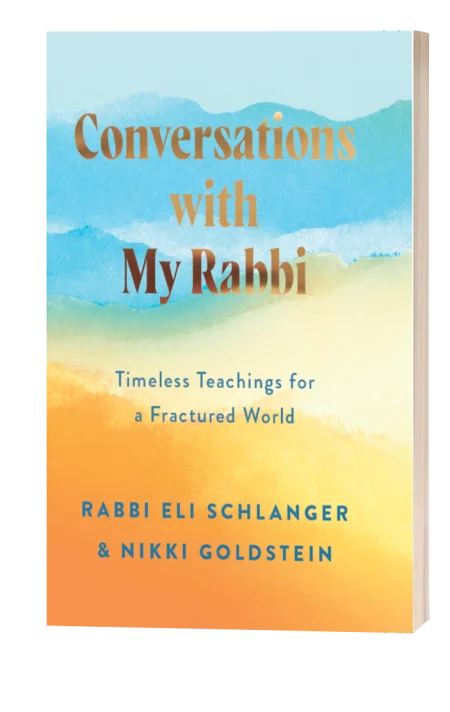
But Schlanger was serious. Over the next two years, the two continued speaking, and over time, a vision for the book emerged. It would be a question-and-answer session between the secular Jew — Goldstein — asking questions about Jewish teachings, and the rabbi — Schlanger — providing answers.
The book would be seven chapters, one for each of the Noahide laws, and target a generally secular audience. Each law serves as a lens for exploring questions about purpose, suffering, family, faith and responsibility.
Goldstein initially doubted the project would find a wide audience, expecting it would appeal mainly to Schlanger’s Chabad community. But the concept worked, and the two got started.
A life memorialized
Perhaps more enlightening than the book’s Torah lessons are the small vignettes of Schlanger’s life that are sprinkled throughout the book. The assistant rabbi for 18 years at Chabad-Lubavitch of Bondi in Sydney is remembered as a deeply human hero and teacher — funny, self‑effacing, drawing stories from his prison chaplaincy, hospital rounds and bustling Chabad life to illustrate abstract ideas.
“Working with Eli was a revelation,” Goldstein said. “Very consciously, he made this sweet, generous, loving invitation for me to have a personal relationship with my God. He never pushed me about religious observance, and never judged me.”
Schlanger was always traveling around Sydney helping people, whether he was bringing matzah or a mezuzah to families or visiting people in the hospital or in prison. Goldstein’s daughter called him the “random rabbi” for the way he would stop by their house, unannounced, to see how he could help.
“He was incredible at just meeting people where they were at. That was his gift,” Goldstein says. “That’s why so many people loved him.”
Goldstein has only one photograph with Schlanger, taken on her backyard deck shortly after she left the hospital, when she was still frail and recovering.
“He called me and said, ‘It’s Sukkot, I’m on my way,’ and turned up with a tent, an etrog and a palm branch,” she recalled. “We did the Sukkot ceremony on my deck. I was probably one of hundreds of people he was looking after like that.”
After Schlanger’s death, the book that Goldstein thought would only sell a few hundred copies was signed to a major publishing deal with HarperCollins and released in late May to a broad international audience. The last chapter, written after Schlanger’s funeral, was composed with the help of Schlanger’s father-in-law, Chabad Rabbi Yehoram Ulman, and other local rabbis.
Goldstein believes Schlanger’s personable teaching style is what makes the book speak to people from all backgrounds.
“You never feel like you are being hit over the head by someone moralizing,” Goldstein said. “You feel like you are being met by somebody human who’d lived his own stories and his own struggles.”
It’s an approach that Goldstein suspects may have defined Schlanger’s final minutes in this world, when he saw a gun pointed at him as he was about to light the menorah. Witnesses have described him trying to speak with the gunman, pleading with him.
“While everyone else hit the ground, Eli raised his hands and looked straight at the shooter,” Goldstein said. “I don’t know exactly what he was thinking at the time, but I absolutely do know that what he was trying to do was protect his community.”
“He was a very brave man, and I’m very certain of that.”