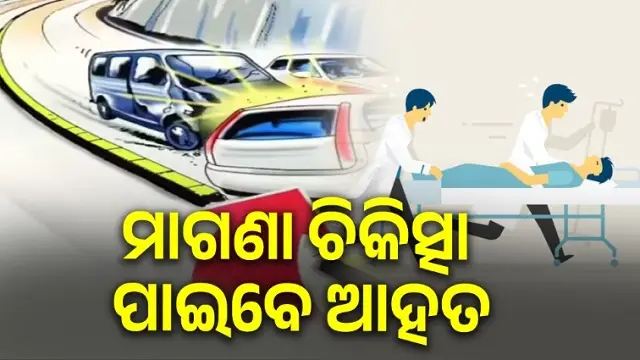
Odisha Crime Branch directs all SPs and DCPs to implement PM RAHAT successfully, road accident victim to get treatment cover up to Rs 1.5 lakh
by Subadh Nayak · KalingaTVAdvertisement
Bhubaneswar: Odisha Crime Branch has reportedly directed all Superintendent of Police (SPs) and Deputy Commissioner of Police (DCPs) to successfully implement the “Prime Minister – Road Accident Victims’ Hospitalisation and Assured Treatment (PM-RAHAT)” scheme through which the road accident victim gets treatment cover up to Rs 1.5 lakh.
As per the directions of the State Chief Secretary and Director General of Police, the police have been asked to verify and approve the data on the eDAR (Electronic Detailed Accident Report) platform within 24 hours in case of minor injuries and 48 hours in case of serious injuries. If the accident occurs in any other police station area, the jurisdictional area has to be changed within 3 hours.
Prime Minister Narendra Modi had launched the PM-RAHAT on February 13, 2026. Know the salient features of the scheme are as under:
- Treatment cover up to ₹1.5 lakh per victim will be provided, subject to a maximum cap of 7 days from the date of accident, on any category of road. The treatment cover will be available to all victims involved in road accidents caused by the use of motor vehicles.
- Every road accident victim shall be provided with stabilization treatment for up to 24 hours in non-life-threatening cases and up to 48 hours in life-threatening cases at designated hospitals, subject to police response.
- This statutory scheme will take precedence over any other Central or State-level schemes.
The scheme has been successfully implemented through the amalgamation of two existing platforms – eDAR (Electronic Detailed Accident Report) used by police officials for reporting accidents and TMS 2.0 (Transaction Management System) of the National Health Authority (NHA), used by hospitals for treatment, claim submissions, and processing of payments.
The reimbursement to hospitals is being done through the Motor Vehicle Accident Fund (MVAF), which is funded through contributions from general insurance companies for cases where the offending motor vehicle is insured, and through budgetary support for uninsured and Hit & Run cases.
Through integration with the 112 Emergency Response Support System (ERSS), the victim or Good Samaritan (RAH-VEER) can obtain necessary information regarding the nearest designated hospital, request an ambulance, or both, as per the situation’s requirements. As soon as the victim is admitted, the treatment process has to be initiated based on the Health Benefit Packages developed by NHA.
In parallel, while initiating the treatment, police authentication of the victim will have to be initiated on the TMS platform. The hospital would generate the treatment ID(s) on TMS and push them to the district police through eDAR. The time available with police for responding on eDAR shall be up to 24 hours, or 48 hours in life-threatening situations, as decided by the hospital administrator.
Advertisement
A complete digital trail for the Scheme will exist from the time of accident reporting through the 112 ERSS platform to victim admission, treatment, police authentication, claim processing, and final payment.
The National Health Authority (NHA) has issued detailed guidelines for the designation and onboarding of additional hospitals by States/UTs vide OM S-12018/81/2024 dated 20.05.2025 to ensure the availability of treatment facilities. As per the Scheme guidelines notified vide S.O. 2489(E) dated 04.06.2025, designated hospitals under the Scheme—including empanelled hospitals under the Ayushman Bharat Pradhan Mantri Jan Arogya Yojana (AB PM-JAY) that comply with the guidelines issued by NHA for this Scheme—shall be deemed designated hospitals for the purposes of the Scheme.
The number of hospitals empanelled under NHA for Ayushman Bharat Pradhan Mantri Jan Arogya Yojana is 36,112 as on 09.03.2026.
To ensure transparency and prevent misuse, the Scheme operates through an end-to-end digital workflow integrating TMS 2.0 and the eDAR platform, creating an electronic linkage between accident details and treatment records for each case. Further, to ensure timely payment to hospitals providing cashless treatment under the Scheme, a period of 10 days has been defined from the date the claim is approved by the State Health Agency (SHA) for District Collectors or the General Insurance (GI) Council to make the payments, as the case may be.
The Scheme also provides for a structured grievance redressal and monitoring mechanism at the District, State, and National levels to ensure effective implementation and timely resolution of issues. Under the Scheme guidelines, District Road Safety Committees (DRSCs) are responsible for overall monitoring and coordination at the district level. A dedicated Grievance Redressal Officer (GRO) or point of contact is required to be appointed at the district level by the DRSC for addressing grievances related to the Scheme.
In case a grievance is not resolved satisfactorily at the district level, the matter may be escalated to the District Collector and thereafter to the State Road Safety Council (SRSC), which functions as the nodal agency for implementation of the Scheme in the respective State or Union Territory. At the national level, an Inter-Ministerial Steering Committee oversees the overall implementation and monitoring of the Scheme, including the review of issues arising during its execution.
The Scheme has been designed in compliance with the statutory mandate of Section 162 of the Motor Vehicles Act, 1988, with the primary objective of ensuring timely and uninterrupted medical care to road accident victims, including during the critical Golden Hour.
Also Read: NCW Chief Vijaya Rahatkar Urges Odisha To Expedite Human Trafficking Cases
Advertisement