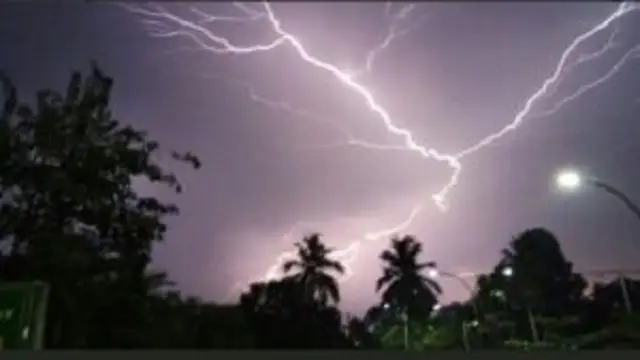
OSDMA to host two-day National Lightning Safety Workshop in Bhubaneswar
by Subadh Nayak · KalingaTVAdvertisement
Bhubaneswar: A national workshop on lightning safety will be held over two days—October 15 and 16, 2026—at Hotel Lemon Tree Premier in Bhubaneswar. The event aims to facilitate discussions on scientific, technical, and administrative measures to reduce fatalities and damage caused by lightning strikes. Revenue and Disaster Management Minister Suresh Pujari, will attend the inaugural ceremony of the workshop.
Leading scientific and technical institutions, universities, disaster management agencies, researchers, and district-level officials from across the country will participate in this two-day national workshop organized by the Odisha State Disaster Management Authority (OSDMA).
The primary objectives of the workshop are to strengthen lightning forecasting, risk assessment, the dissemination of early warnings, and public safety measures. This workshop will place special emphasis on translating scientific knowledge and modern technological advancements into practical measures to safeguard the lives of farmers, agricultural laborers, outdoor workers, students, and residents of vulnerable areas.
On the first day of the workshop, discussions will focus on enhancing lightning detection, monitoring, and forecasting systems through the integration of satellite data, numerical weather prediction, novel applications of Artificial Intelligence and Machine Learning, and panchayat-level decision-support systems.
In this session, the India Meteorological Department (IMD), Indian Institute of Tropical Meteorology (IITM), National Remote Sensing Centre (NRSC), National Centre for Earth Science Studies (NCESS), National Centre for Medium Range Weather Forecasting (NCMRWF), Indian Institute of Technology Bhubaneswar (IIT Bhubaneswar), Fakir Mohan University, National Institute of Technology Patna (NIT Patna), Council on Energy, Environment and Water, Central University of Jharkhand, CSIR National Institute of Data Science and Artificial Intelligence, Tripura University, Berhampur University, Siksha ‘O’ Anusandhan University, and experts from the Resilient Observing Systems Promotion Council (CROPC) and Cape Electric will share their knowledge and experience. These sessions will focus on enhancing the accuracy of lightning forecasts, extending the lead time for early warnings, and utilizing scientific data for local-level decision-making.
On the second day of the workshop, discussions will be held on practical measures to prevent deaths and injuries caused by lightning strikes. This will cover topics such as the preparation of a lightning risk reduction roadmap for Odisha, the identification and mapping of lightning-prone hotspots, risk mapping methodologies, risk assessment for farmers, safety standards regarding lightning, the construction of low-cost lightning shelters, and emergency management for lightning-strike victims.
Advertisement
A special session will be organized to discuss how scientific warnings can be translated into timely and actionable safety messages for farmers, schools, outdoor workers, and local communities. This session will deliberate on how to further strengthen the system for disseminating early warnings to the last mile through the use of SMS, mobile applications, IVRS, sirens, local announcements, and community-based communication networks.
In this workshop, experts and government representatives will come together to discuss the formulation of a Standard Operating Procedure (SOP) for lightning safety and a proposed action plan for the year 2027. Emphasis will be placed on determining various levels of early warning, identifying the responsibilities of different departments and administrative tiers, establishing emergency response procedures, and formulating standard indicators to monitor implementation progress.
The workshop is expected to yield a “Lightning-Safe Odisha: 2027 Action Plan and 2027–2030 Roadmap.” This proposed roadmap will outline a clear framework for coordinated action across areas such as lightning forecasting, vulnerability reduction, public awareness, dissemination of early warnings, and emergency response.
Through this workshop, Odisha will take a significant step towards strengthening coordination among scientific research, government policy formulation, and community-level action, with the aim of preventing lightning-related fatalities and enhancing public safety against lightning hazards.
It is worth noting that the OSDMA is continuously striving to strengthen disaster preparedness and response mechanisms across the board.
Also Read: Karnataka: Two Women Killed In Lightning Strike In Kalaburagi District
Advertisement