In DC, Netanyahu showcases diplomatic wins, but they all have expiration dates
PM emerges glowing from meeting with Trump, poses with evangelicals and takes on NYC’s Mamdani; but with US elections looming, Israel may soon face a wake-up call
by Ron Kampeas · The Times of IsraelJTA — A rejuvenated Prime Minister Benjamin Netanyahu returned home to Israel Thursday from Washington, having crossed off everything on his diplomatic shopping list.
Grinning photo op with US President Donald Trump? Check. Iran still a top priority? Check. Conciliation with US Vice President JD Vance and conflict with New York Mayor Zohran Mamdani? Check and check. Meetings with top-level senators and with salt-of-the-earth pro-Israel Americans? Check, check and check!
Had he checked his pen, however, Netanyahu might have found that the ink was running out. To the degree that the prime minister scored public relations victories during his visit to the US this week, they all have impending expiration dates.
Netanyahu, who faces a tough reelection campaign for the elections to be held on October 27, needs to show the Israeli voters that his claimed superpower, influencing Americans to support the Jewish state, is still potent. His rivals are already making the case that his power is spent.
“Netanyahu’s expectation and hope is that Trump will establish, figuratively speaking, a re-elect Benjamin Netanyahu headquarters in Washington for the next three months,” said Aaron David Miller, a veteran Middle East negotiator under Republican and Democratic administrations who is now a senior fellow at the Carnegie Endowment for International Peace.
The prime minister seemed genuinely elated on Tuesday after he and the US president met at the White House. Contrary to reports ahead of the meeting, Netanyahu said he was not seeking to pull the United States back into an all-out war. Instead, he wanted to see eye-to-eye with Trump on what happens if the talks to end the war fail.
He told ABC News in an interview he was in lock-step with Trump over the three options ahead: “One, to indeed succeed making a deal; two, to continue a blockade; three, to take military action,” Netanyahu said. “Anything that will produce the end of Iran’s nuclear program is what we want. That’s our common goal. We talked about it.”
The problem for Netanyahu is that the deal Trump seeks is anything but satisfying to Israel: The Memorandum of Understanding Vance reached in June, just weeks before the war resumed, allows Iran a stake in controlling — and even profiting from — the Strait of Hormuz, the waterway through which one-fifth of the world’s petroleum transits, a prerogative the Islamic Republic never before enjoyed.
Privately, Israeli officials have said they don’t expect the deal to happen, and that Trump will eventually turn to options two and three, which the Israelis favor. But Trump’s popularity is cratering ahead of critical midterm elections, inflation is not abating, and even as Iran takes shots at ships in the Strait of Hormuz and its US-allied neighbors, Trump keeps banking on a deal.
“There are very friendly negotiations going on,” he said Monday, the day Netanyahu arrived. “I think there’s a good chance that something could happen.”
But diplomacy wasn’t the only concern during Netanyahu’s visit. Domestic politics dogged Netanyahu in the US capital. Opposition Leader Yair Lapid was also in town. Both were ostensibly there for the funeral of South Carolina Republican Sen. Lindsey Graham, a pro-Israel stalwart who backed the Iran war. Lapid, in a talk to The Atlantic Council, took shots at Netanyahu’s public diplomacy, saying his attacks on Democrats who were critical of Israel were making the country more isolated.
Press releases from Netanyahu’s office sought to reinforce his status as the explainer-in-chief: He met with prominent senators; he met with Cabinet officials; he met, above all, with Trump.
Yet these releases undercut any claim Netanyahu might have had to the prominence he once enjoyed in the American mind.
The single Democratic senator he met with was John Fetterman of Pennsylvania, whose robust support for Israel makes him an outlier in his party — something Fetterman repeatedly emphasized in the chat Netanyahu’s office posted. “It’s been disappointing as a Democratic politician, how our party continues to behave,” Fetterman said.
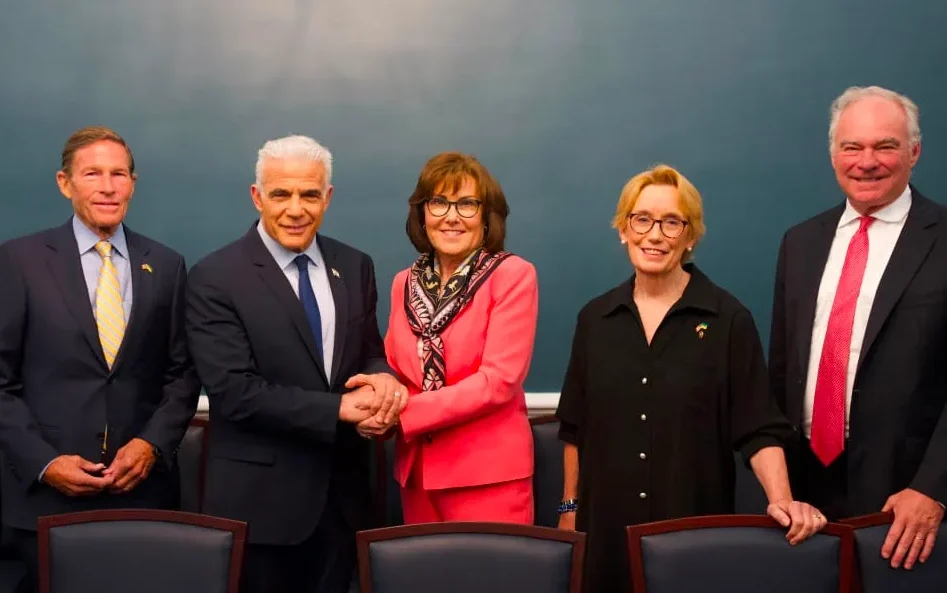
Lapid, by contrast, posed for a photo with Democratic senators, including some who have recently criticized Israel stridently, like Sen. Tim Kaine of Virginia. “Boycotting those who oppose you is not the way,” Lapid said on X. ”Repair relations with both parties. It’s not always fun, but that’s what it takes. Not by whining and not by boycotts.”
Netanyahu’s failure to engage with the American left was also evident in a video of his meeting with evangelicals. “I’m very grateful to you for your consistent support, for the constancy of your friendship, and now it’s time to fight, fight, fight,” he said, evoking Trump’s famous call when he escaped an assassin’s bullet in 2024.
That prompted Mike Evans, an author who is an outlier among evangelicals for his stridency in advocating for extreme right positions, to lash out at the left using apocalyptic language. “We are fighting right now against the dark side, the leftist, godless dark side, but by the grace of God, we’re going to win this battle,” he said.
Netanyahu also took on Mamdani, who has called for his arrest, likening his administration of the city to the Nazi era in an interview on Fox News. Mamdani’s wish was never going to come through — he ultimately acknowledged he had no power to arrest Netanyahu — yet his sentiment had staying power: A poll showed 49 percent of Americans agreed that Netanyahu should be arrested.
Linsey Davis, the ABC reporter who interviewed Netanyahu, pressed him on Israel’s plummeting popularity. Netanyahu blamed the rise of social media and said it concerned him — but notably did not explain how he planned to counter what he described as a propaganda threat to American and Israeli interests.
“I think there’s been a change because of the proliferation of social media and the fact that sovereign countries have manipulated bot farms and other things, and we can see a direct relationship between the proliferation of social media and the decline in support for Israel,” he said. “Does it concern me? Yes, yes it does. And I want bipartisan support for Israel because I think that’s the fundament of our national security.”
Netanyahu could point to one seeming public diplomacy success: He met with Vance, likely to be a frontrunner for the GOP presidential nomination in 2028, and the vanguard of the GOP sector that is growing disaffected with Israel. A US official told Axios the meeting was “cordial and productive,” diplomatic-speak for not warm.
As for the flurry of photo-ops the prime minister’s office sent out from the trip, the one-on-one with Vance was not among them.