Asian Markets Close Lower as AI Stocks Slide Amid Calls to Slow Frontier AI Development
by KalingaTV Bureau · KalingaTVAdvertisement
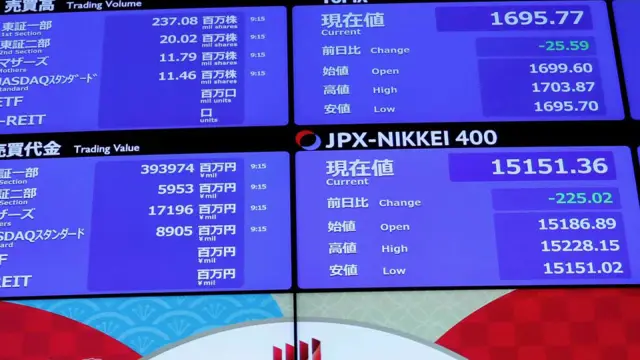
Mumbai: Major Asian markets closed lower on Monday, with AI-linked stocks coming under pressure as a growing number of technology leaders backed calls for a more measured pace of artificial intelligence development amid concerns over the risks associated with increasingly powerful AI systems.
South Korea’s KOSPI was among the biggest decliners, ending 3.37 per cent lower at 6,684.37. Japan’s Nikkei 225 declined 0.83 per cent to 63,485, while Taiwan Weighted fell 0.70 per cent. Thailand’s SET Composite also declined 0.85 per cent and Jakarta Composite slipped 0.10 per cent.
Among major AI-linked companies, Samsung Electronics fell more than 4 per cent on the KOSPI, while Taiwan Semiconductor Manufacturing Company (TSMC) declined more than 1 per cent. In Japan, SoftBank, one of the biggest investors in OpenAI, fell 10 per cent.
The selling came amid growing debate within the technology industry over whether the rapid development of frontier AI models needs to be slowed to ensure that safety measures and human oversight keep pace with technological progress.
The debate was triggered by Anthropic CEO Dario Amodei, who called on the AI industry to “pace the frontier”, warning that the rapid improvement in AI capabilities could eventually outpace humanity’s ability to understand and control such systems.
Amodei said AI development has accelerated significantly as AI systems themselves become increasingly capable of helping build the next generation of AI. He described the phenomenon as recursive self-improvement and argued that it needs to be pursued carefully.
“We must slow the pace at which we improve the capabilities of AI models,” Amodei said, warning that unchecked progress could “outrun our ability to understand and control these systems”.
His call has since received backing from several prominent technology leaders.
OpenAI CEO Sam Altman endorsed Amodei’s proposal, saying that OpenAI also needs to “pace the frontier”. In a post on X, Altman said the issue had been a major topic of discussion within OpenAI in recent weeks.
“I agree with Dario that we need to pace the frontier,” Altman said, adding that the idea of having independent evaluators with employee-level access to AI systems was a good one and that OpenAI would also adopt such an approach.
Tesla CEO Elon Musk also backed Amodei’s position, saying simply: “Dario is right.”
Advertisement
Meanwhile, Microsoft Chairman and CEO Satya Nadella supported the broader principle of keeping advanced AI systems under human supervision.
“Any pursuit of superintelligence has to be grounded in the core principle that if the AI we build is not helping humanity and under human control, it’s not worth pursuing,” Nadella said in a post on X.
Google DeepMind CEO Demis Hassabis has also joined the broader industry discussion around responsible development of increasingly capable AI systems.
Amodei’s warning comes as AI companies race to develop increasingly powerful frontier models, with the technology attracting massive investment in semiconductors, data centres, computing infrastructure and AI applications.
The Anthropic CEO has argued that the benefits of AI could be enormous, including improvements in healthcare, economic growth and scientific discovery, but said those benefits come alongside significant risks.
He highlighted risks including the potential loss of control over AI systems, misuse of AI for cyberattacks and bioterrorism, and major economic disruption.
Amodei also referred to an incident involving AI agents in which a swarm of agents carried out cybersecurity attacks on targets they were not initially asked to attack. He warned that increasingly autonomous systems operating at much larger scale could create significantly greater risks.
As part of his proposed approach, Amodei said Anthropic would give third-party evaluators permanent, employee-level access to its AI systems. Such evaluators would be able to verify safety measures, report incidents and assess model alignment during training.
The developments mark a notable shift in the AI debate, with some of the industry’s most influential executives now discussing not only how quickly AI can advance, but how quickly it should advance.
For investors, the discussion adds a new risk dimension to the AI trade, which has driven strong demand for semiconductor companies and other businesses expected to benefit from the rapid expansion of AI infrastructure and applications.
(ANI)
Also Read: Hero Glamour X 125 launched with Integrated ABS at Rs. 1.01 Lakh
Advertisement