From its electric melee fights to its surprise Firewatch nods, Control Resonant's radical sequelcraft looks like it might just pay off
Slashing my doubts to shimmering red ribbons
· Rock Paper ShotgunIt seems appropriate that Control Resonant drags the Remedyverse back away from Alan Wake II’s screeching horror, as it’s spent the past few weeks – and as of yesterday, about three hours of playable preview build – assuaging my fears. Control the First, in my defence, took its kinetically supernatural shooting, put it in the hands of a likeable hero, and wrapped everything in a delightfully weird megastructure of brutalist concrete. Could Resonant get away with changing all three?
On the basis of that preview, this humbled hack says: yes. And it could end up even better.
The melee brawling, for one thing, is a hoot. Newly minted, poorly hairstyled lead Dylan Faden doesn’t initially take to his sci-magic powers as effortlessly as sister Jesse did – his double-jumps and levitations exhibit the flailing legs of someone about 0.02 seconds away from being knocked out of Takeshi’s Castle. Still, after a few practice rounds with the Abberant, his shapeshifting hammer/spear/axe/nunchucks, he emerges as a much faster, much fiercer fighter.
Combat, thus, lands somewhere between the air juggles and particle effect chaos of Devil May Cry and the smooth mook-to-mook transitions of a Batman Arkham. Resonant then cranks up the pace of both, producing breathlessly uptempo encounters marked by lengthy combos and desperate dashing. Sometimes quite literally breathless – I caught myself audibly exhaling after a couple of knife’s-edge skirmishes.
In terms of influences, mind, there’s still veins of Control running through it. Just as the original’s gunslinging only truly came alive when you could supplement it with telekinetically lobbed furniture, Dylan’s powers – a customisable set of ground slams, energy bursts, improvised shielding and so on – feel as practical and essential as direct strikes. There’s a similar sense of impetus, too. Control encouraged you not to cower behind cover, but to fly over it and start chucking tables; Resonant may up the danger by dumping you in bigger crowds of sharper-clawed Hiss, but aggressive thwacking is still the best way to stay alive, slain foes exploding in clouds of red smoke and precious, glowing healing orbs.
According to lead game designer Sergey Mohov, who I spoke to in a breath-catching break from the massacre, this proactive approach was one that Remedy wanted to implement from the start. Mohov notes the rise of parrying, blocking, and other defensive play in contemporary melee fighters, and suggests Resonant is a happily bloodlusting antithesis.
"When you think about some of the examples of games out there, like character action games or other melee-based games, a lot of them are you standing in the middle of an arena, and enemies are coming to you in, like, a Jean Claude Van Damme movie kind of thing," he says. "We wanted to be the opposite. We want you to be a supernatural monster hunter, and enemies are afraid of you."
I will say that they certainly don’t act afraid – Resonant’s baddies attack enthusiastically and in potentially huge waves, to a degree that might have felt unfair were Dylan not such an agile battlemage. In another conscious departure from the original, you’re also no longer mostly fighting red-tinted, but ultimately still human-shaped thralls. Most of the beasties here are properly warped, almost demonic fleshsticks, all stretched-out limbs and impossibly folded skin. Bosses and elites embrace an especially elevated strangeness: you may have seen the gigantic half-face fused into chunks of pavement, and at one point I was set upon by a flying, laser-shooting abomination that looked like a crimson manta ray with the head of a gasmasked WW1 soldier. Later, I fought half of an upturned bus, a richly Remedy-flavoured example of the "city geometry merging together with humans" that Mohov warned of during our chat.
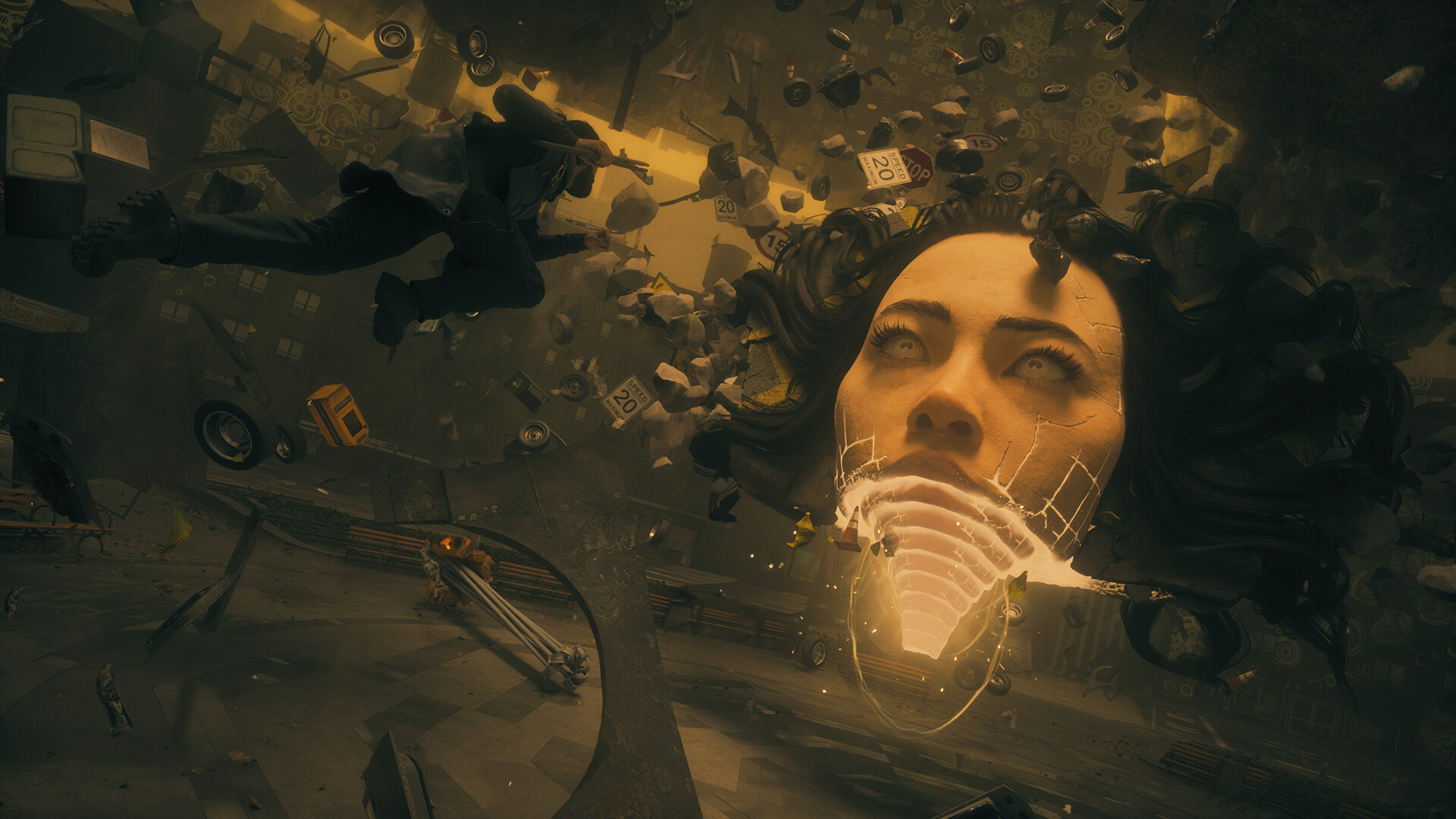
"It doesn’t care," Mohov says of the extradimensional threat that’s mushing bits of Manhattan together like mismatched Lego. This disregard for logic is visible elsewhere across New York: an abandoned car distorted as if flicked by a divine painter’s brush, trails of tragically cawing birds frozen helplessly in time. Perhaps my biggest concern about leaving the shifting grey blockiness of Control’s Oldest House for the well-trodden streets of NYC was the loss of that singular visual identity, but Resonant’s take on the latter is already looking like a sufficiently odd successor.
"I think one thing about Manhattan in Resonant is that it's not trying to represent real Manhattan, exactly," Mohov explains. "It's kind of like the movie version of Manhattan. It's kind of like a dream reality, a little bit, because there are things there that you’d only find in the collective subconscious - what you think about when you imagine what Manhattan is like in the movie Taxi, or in the John Woo movies. That's what we are trying to do here - it’s like we have our own version of this reality that is quite different, like the Remedy version of it.
"For instance, I have one quite silly, small example, but I think it's illustrative: we have phone booths all around the city, because that's what people imagine there to be in this city. But actually, the actual real city of New York took down the last phone booth in 2022. It's not exactly one to one with the real world. And then, of course, it's been twisted and transformed by all of these different threats that escaped the Oldest House."
We got phone booths is underselling things slightly; Manhattan has been torn asunder, then photocopied and glued back together in recursive, twisting, sometimes darkly beautiful patterns. Resonant also continues the Control tendency to play with space: my demo took me to the Sinkhole, a labyrinth of endlessly interconnected apartment bedrooms and kitchens that eventually opens up into an immense cavern of upside-down, sideways-shifted rental rooms. A six-ways fold in reality, that feels tricky to navigate even for the gravity-defying Dylan.
This guy’s winning me over too, y’know. A smug Hiss pawn and longtime prisoner in Control, Dylan doesn’t have the instant relatability of his (relative) everywoman sister. But freedom suits him, it turns out, and for all his hyper-competency as a killing machine, he’s played by voice/face provider Sean Durrie with disarming mixture of self-doubt and quiet determination. Also, a dash of childish unfamiliarity with the world he’s fled into, a shortcoming quickly accounted for by the addition of his handler Zoe, who’s usually around to instruct and/or berate him over the radio.
Dylan’s pilfered walkie-talkie also provides another addition: multiple-choice chatting moments, where observing a point of interest will prompt either Zoe or Dylan himself to call the other and discuss it. And if that sounds like it’s inspired by a certain rural walking sim about a bloke with giant hands, that's because it is.
"We actually looked at Firewatch," Mohov says, seconds before I can ask him if they’d looked at Firewatch. "That whole thing with Delilah, like the dynamic interchange between these two characters, and the relationship that they're building together, is also how we're telling the story of Dylan learning about the real world. Because Zoe knows about the real world, and Dylan doesn’t, and Dylan knows about the FBC, and Zoe doesn't."
Personal pow-wows aren't what I was expecting from a sequel to the usually lonely Control, but then I also didn’t expect it to turn into a deliciously free-flowing character action RPG. Or for the offbeat vibes and visual spectacles of the Oldest House – still one of my favourite places in modern games – to be matched and even surpassed with such confidence. As it stands, I’d be very, very happy for Control Resonant to keep proving me wrong. It’s out September 24th.